Re: Entwicklungen Fliegerabwehr
Verfasst: Di 21. Mär 2023, 21:12
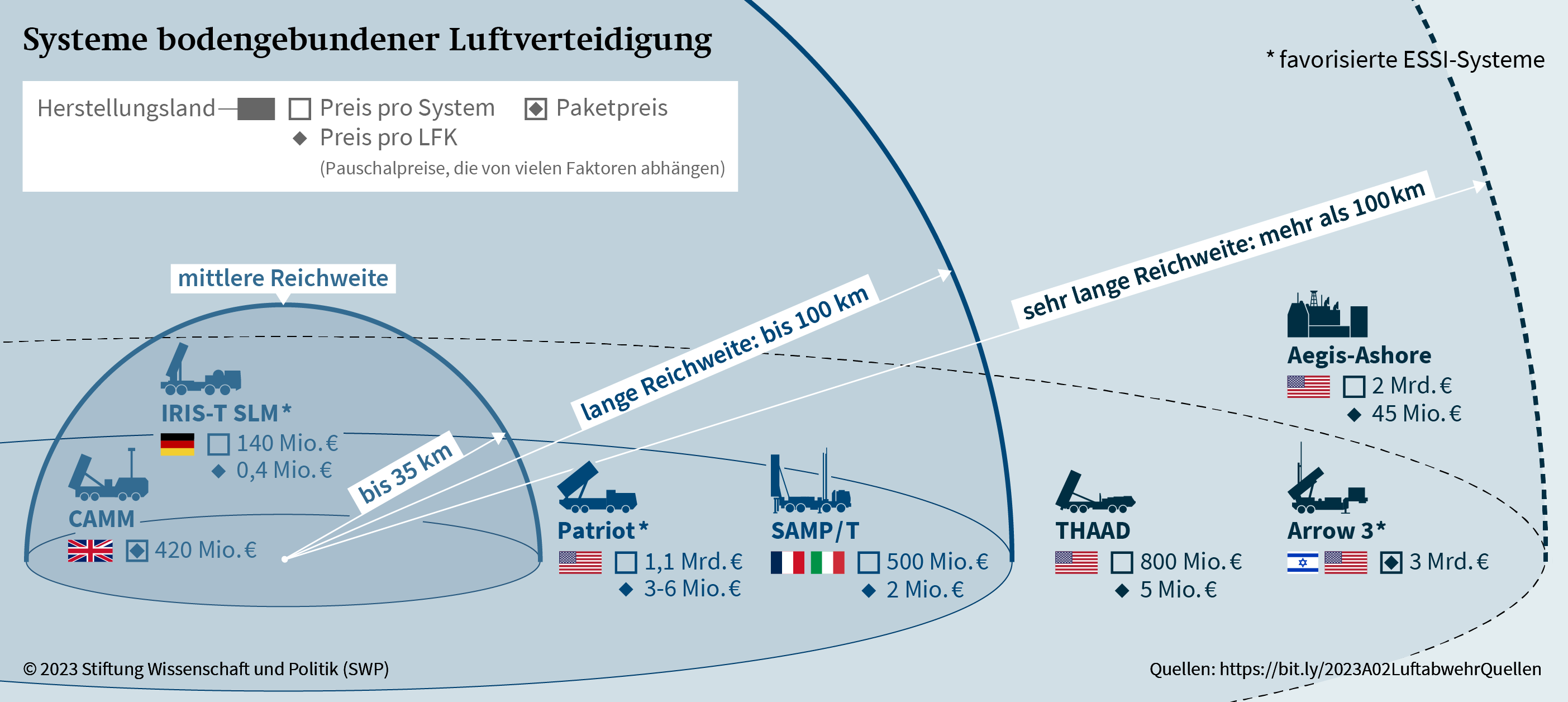
IRIS-T SLM soll ja beim Sky Shield zum Einsatz kommen. Eine gemeinsame Beschaffung ist schon sehr wahrscheinlich.
Forum für Österreichs Militärgeschichte
https://www.doppeladler.com/da/forum/
IRIS-T SLS (= IRIS-T am EF) ist auch bereits in NASAMS-3 integriert.
Improved Missile and New Radars Form Modernized SAMP/T (16. November 2021)maro-airpower hat geschrieben: ↑Di 21. Mär 2023, 22:09Und da gehts nicht nur um Raketen - auch X-Band-Radar - und das wird man brauchen für Raketenabwehr - fällt mir keines ein von EU-Herstellern.
The Eurosam consortium of MBDA and Thales were contracted to develop the SAMP/T NG (New Generation) by the European defense materiel agency OCCAR in March 2021, but details of the upgrade program have only now emerged at the Dubai Airshow.
At the heart of SAMP/T NG will be the longer-range and more capable two-stage Aster Block 1NT missile, which introduces a new Ka-band radio-frequency seeker and onboard computer as well as improved pyrotechnics. Target detection will be undertaken by one of two multi-function radars: Leonardo’s Kronos Grand High Power sensor or the Thales Ground Fire 300.
The Kronos radar will be used by Italy, while the Thales radar will be used by France. Both sensors are 360-deg.-field-of-view active electronically scanned array (AESA) radars featuring gallium-nitride semiconductor technology.
https://aviationweek.com/shownews/dubai ... ized-samptWith the new the radar, the range of detection is increased to 350 km (218 mi.), while the missile is now able to engage targets out to a distance of 150 km.
Improvements made to the system will increase its capabilities against a range of aerial targets including drones and ballistic missiles, Eva Bruxmeier, managing director of Eurosam, told journalists Nov. 15 in Dubai.


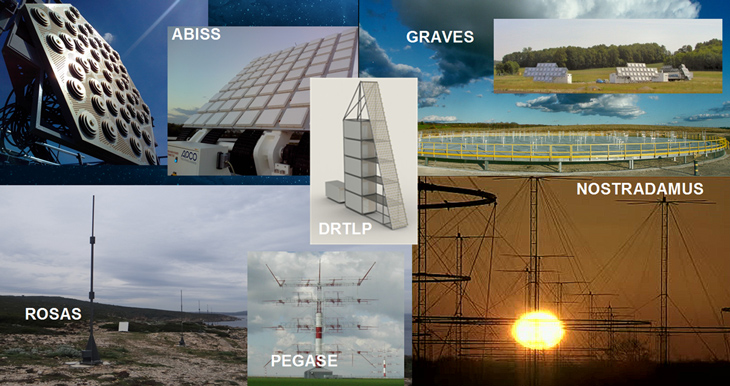
https://ceas.org/wp-content/uploads/202 ... 2-2017.pdfTLP Very Long Range Radar (Figure 3a) is a key element for early warning function in order to compute all types of ballistic threat. This ground-based low frequency sensor is a radar realizing the surveillance and acquisition of the ballistic missile target in its ascending and ballistic phases to produce trajectory parameters. The operation in Low Frequency band brings unsurpassable assets for the long range detection of the high endo and exo atmospheric ballistic missiles. Moreover TLP can provide cueing data to Centimetric band Fire Control Radar by integration in BMD system.
The Very Long Range Radar is an active phased array technology (AESA) and multifunction radar based on fence surveillance interleaved - as soon as a target is detected – with a tracking mode based on specific tracking beams.
French MoD awarded a risk reduction contract to Thales and ONERA in October 2011 for the development and the experimentation of a radar demonstrator based on the principle of one column of the radar (Figure 3b) defined in the concept study.
In addition to column, the demonstrator solution (Figure 3c) integrates real time software in term of signal processing and data processing. As operational radar, it includes HMI with Aerospace visualization, supervision statement and built in test dispositive.
The objective of demonstrator is double:
- Validation of architecture and technology choices;
Nowadays integration on site is closed in order to process phase of experimentation.
- Evaluation of the detection and accuracy performances in order to anticipate operational performances of the Very Long Range Radar.
https://www.onera.fr/sites/default/file ... 017-va.pdfVery long range radar: ONERA conducts the first tests on a calibration sphere
The DRTLP is a risk-removing demonstrator aimed at confirming the feasibility of a complete advanced warning radar (for the detection and tracking of ballistic missiles) and at specifying its performance. The radar concept is based on state-of-the-art technology, which ONERA is contributing to enrich: active electronic scanning antenna, digital reception channel, etc.
In collaboration with Thales, via a contract awarded by the DGA in 2011, an important system integration stage was completed at the end of 2017 at the DGA’s Hourtin site. After the qualification of the equipment and the integration of the software, the entire set of equipment set up in a structure nearly twenty meters high, representing 1/8 th of a full radar potential, enabled the first measurements to be obtained. This opens up an experimental phase to qualify and validate the demonstrator performance, and to anticipate the future performance of a complete operational system.

https://www.esa.int/esapub/bulletin/bul ... inkrad.pdfFylingdales
The most powerful space surveillance sensor in Europe is located in Fylingdales (UK) and is operated by the British armed forces. Most of the activities are geared to the US Space Surveillance Network (SSN) early warning and space surveillance mission.
Technical specs: The Fylingdales complex consists of a high-performance 3-face, phased-array radar operating in the UHF-band. Technical details not openly available.
Globus II
A second facility associated with the US SSN is the Norwegian Globus II radar. It is located in Vardø, at the northernmost tip of Norway. Due to special bilateral agreements between the US SSN and the operators of Fylingdales and Globus II, data from these sites have so far not been available for unclassified use within Europe.
Technical specs: Globus II is an X-band mono-pulse radar, with a 27 m parabolic dish antenna, housed in a 35 m radome.
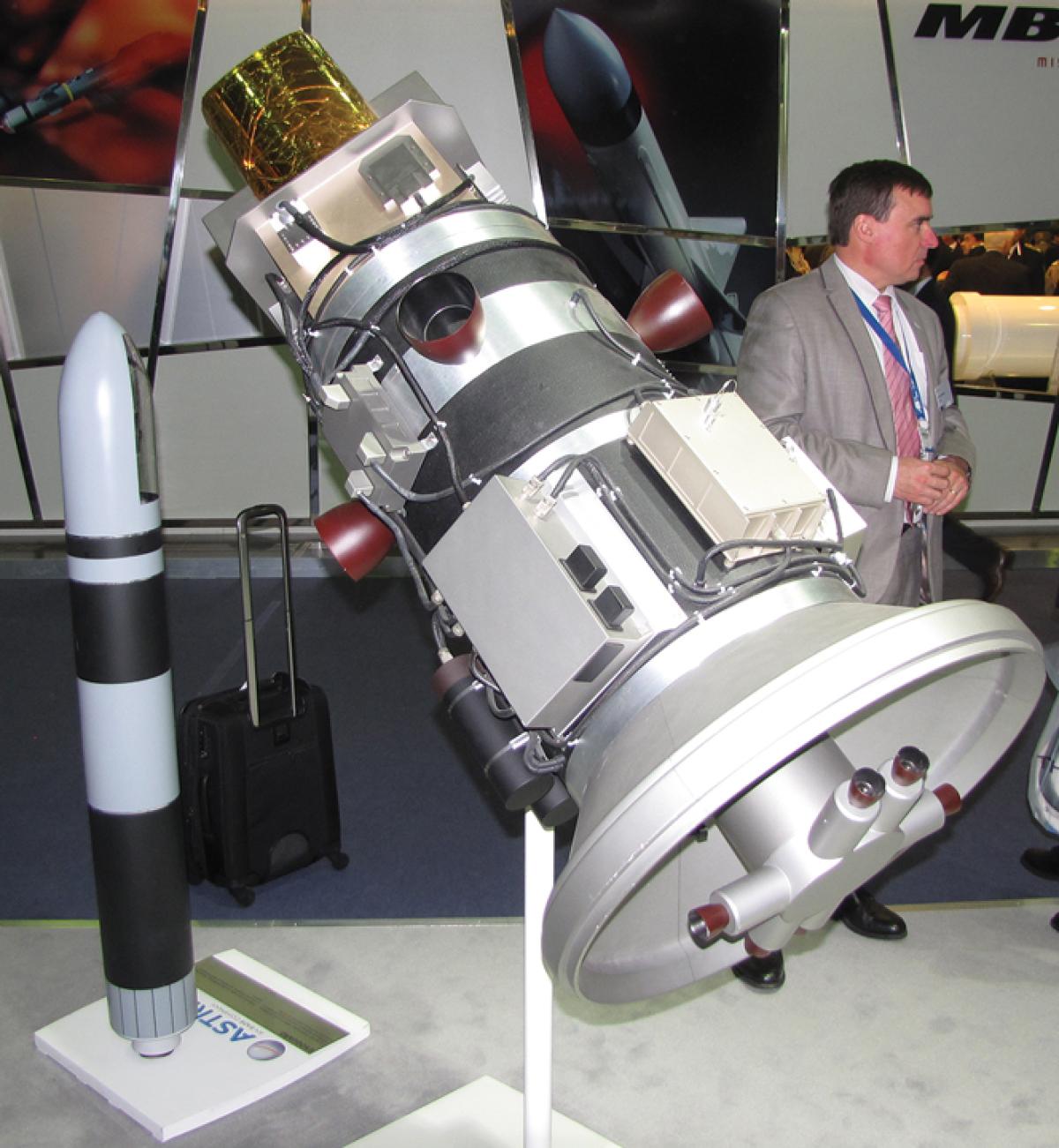
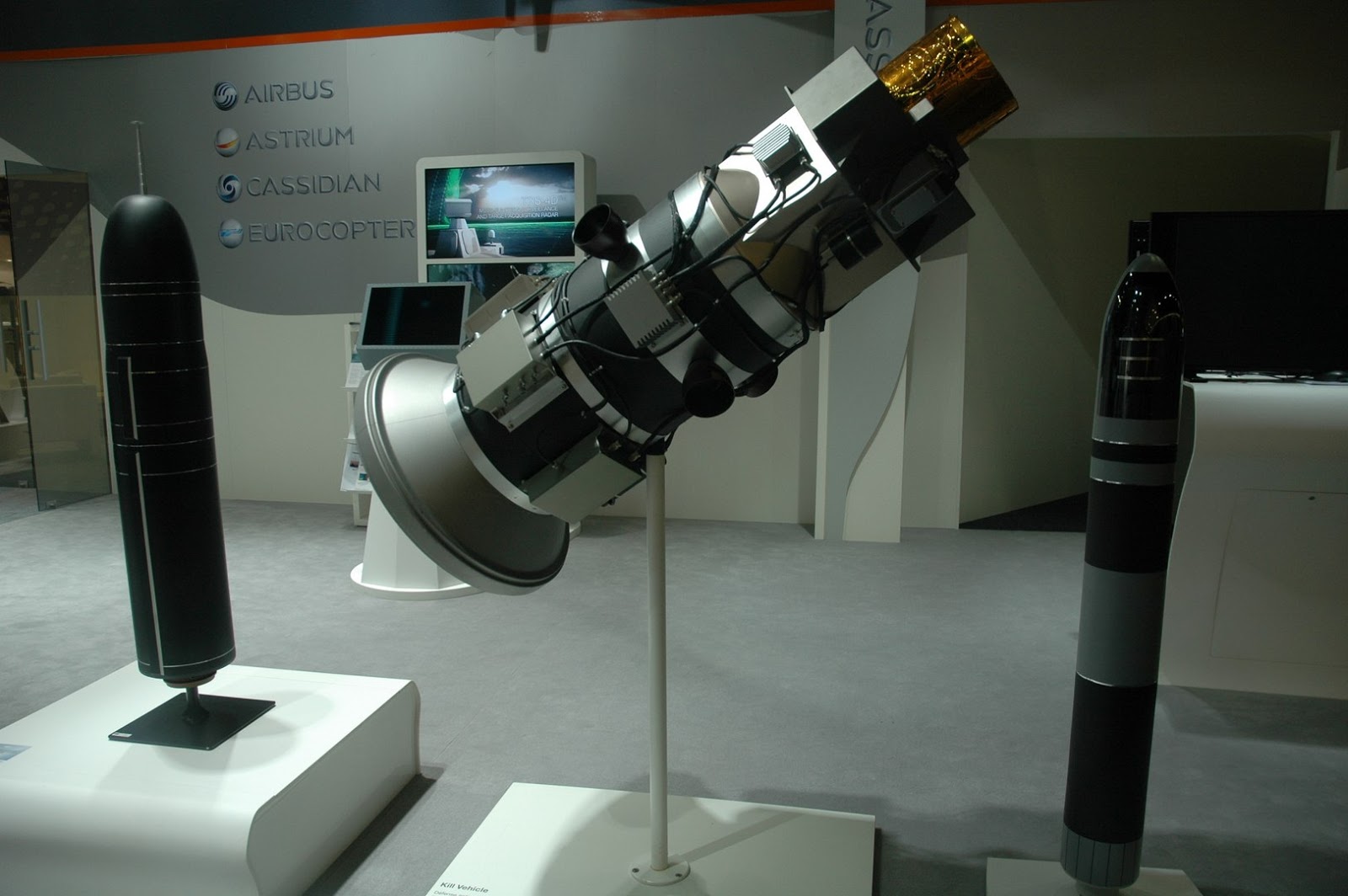
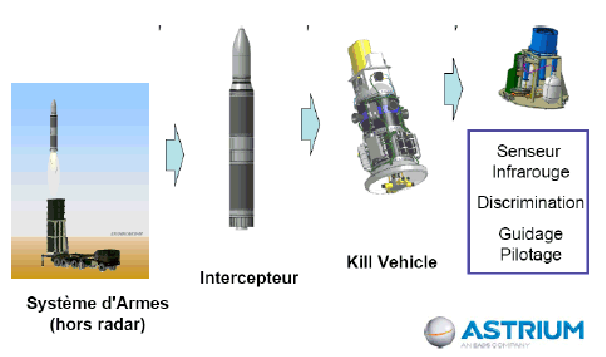
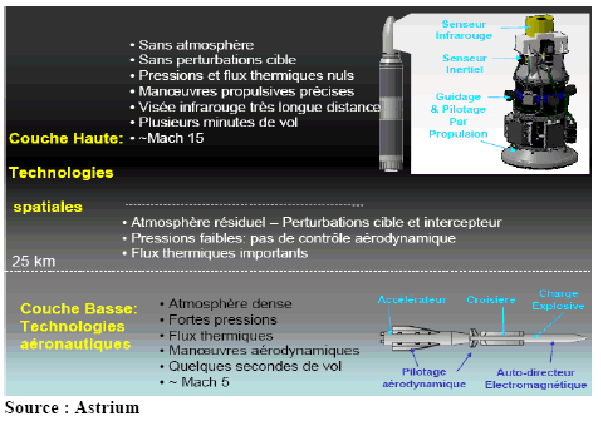
https://www.usni.org/magazines/proceedi ... teals-showEADS (European Aerospace Defense Systems), a Franco-German company, showed a model of an Exoguard missile that could be fired out of either the U.S. Mk-41 vertical launcher or the French Sylver (as in the current Franco-Italian frigates). It also displayed a model of the kinetic-energy kill vehicle that the missile would carry. There were no accompanying brochures, but the missile figured in a formal report to the French Senate last year.
Dazu müsste es erst einmal fertig entwickelt sein. Bislang gibt es für dieses System noch nicht einmal einen Flugkörper. Letzter Informationsstand ist, dass es bereits einen Exportkunden gibt, der identisch zum Exportkunden für IRIS-T SLM ist (sprich: Ägypten), die ersten Testschüsse beim Kunden 2024 durchgeführt werden und das System 2025 einsatzbereit sein soll.Verweigerer hat geschrieben: ↑Mi 22. Mär 2023, 09:39 Also mit Iris-T-SLX könnte Österreich in ein paar Jahren schon recht gut leben.

A significant upgrade of the IRIS-T AAM, the canister-launched IRIS-T SL introduces a new smokeless and insensitive enhanced rocket motor, an aerodynamic hood for extended range, a datalink, and an autonomous GPS/INS navigation system; however, the missile retains the IRIS-T AAM high-explosive/fragmentation warhead.
[...]
The missile's vertical launch enables comprehensive 360° protection - at ranges out to 40 km and altitudes up to 20 km, and with a negligible inner dead zone because of the missile's thrust vector-control capability - against a catalogue of threats, including aircraft, armoured helicopters, drones, missiles, and large calibre rockets (but not ballistic missiles), a target spectrum similar to that of the IRIS-T AAM.
Buschek confirmed that Diehl Defence is in development of a brand-new interceptor for use with its future IRIS-T SLX long-range air defence system.
"The idea is to use the design of the IRIS-T SL, but to increase the range and altitude capability, which in general means a larger rocket motor. We intend to keep the roll-pitch IIR seeker, but we will add an RF [radio-frequency] sensor to have a dual-mode seeker. So, the main characteristics of the new interceptor will be a bigger rocket motor to achieve the longer range, and a dual-mode seeker, which will be incorporated from the beginning," he added. Buschek confirmed that the new long-range interceptor will have a different warhead, although he declined to disclose further detail on the warhead type.
After discussions with our customers, we decided - as an intermediate step - to go for a longer-range interceptor - not necessarily a ballistic missile defence interceptor, but a longer-range missile - with the ability to intercept higher flying targets, such as higher-flying bombers, UAVs, etc, at ranges up to 80 km and at altitudes up to 30 km.
Schon richtig theoderich;-) Ich schrieb ja auch von den kommenden Jahren. Da erwarte ich doch schon bald dementsprechende Flugkörper. Die deutsche Rüstungsindustrie nimmt gerade wieder ein bisschen Schwung auf.theoderich hat geschrieben: ↑Mi 22. Mär 2023, 12:37Dazu müsste es erst einmal fertig entwickelt sein. Bislang gibt es für dieses System noch nicht einmal einen Flugkörper.Verweigerer hat geschrieben: ↑Mi 22. Mär 2023, 09:39 Also mit Iris-T-SLX könnte Österreich in ein paar Jahren schon recht gut leben.
Mit der "Begleit-FlA" ist wohl eine Fliegerabwehrsystem auf Basis des Pandur EVO gemeint. Und das wird sicher keine IRIS-T SL sein. Bestenfalls IRIS-T SLS, wie in Norwegen:Verweigerer hat geschrieben: ↑Mi 22. Mär 2023, 12:44Und als Begleit-FlA nehme ich auch SLM. Die stelle ich doch taktisch aufgesattelt irgendwo großzügig hin

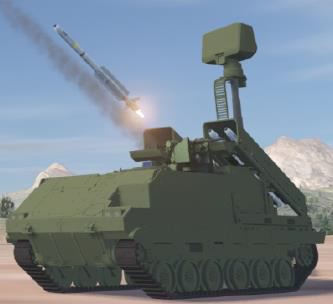
Das wäre auch mein Gedanke. Radar und TOC sind ja bei den verschiedenen Varianten identisch, es lassen sich bis zu 6 Starter anbinden. Als "Minimalkonfiguration" je ein SLS, SLM und SLX Starter oder eben jeweils zwei.Verweigerer hat geschrieben: ↑Mi 22. Mär 2023, 12:44 Aber mal angenommen: Könnte man nicht auch switchen innerhalb eines Systems wie Iris-T? Zum Beispiel 3 x SLX, 3 x SLM? In Kombination halt und auf den Kunden abgestimmt.