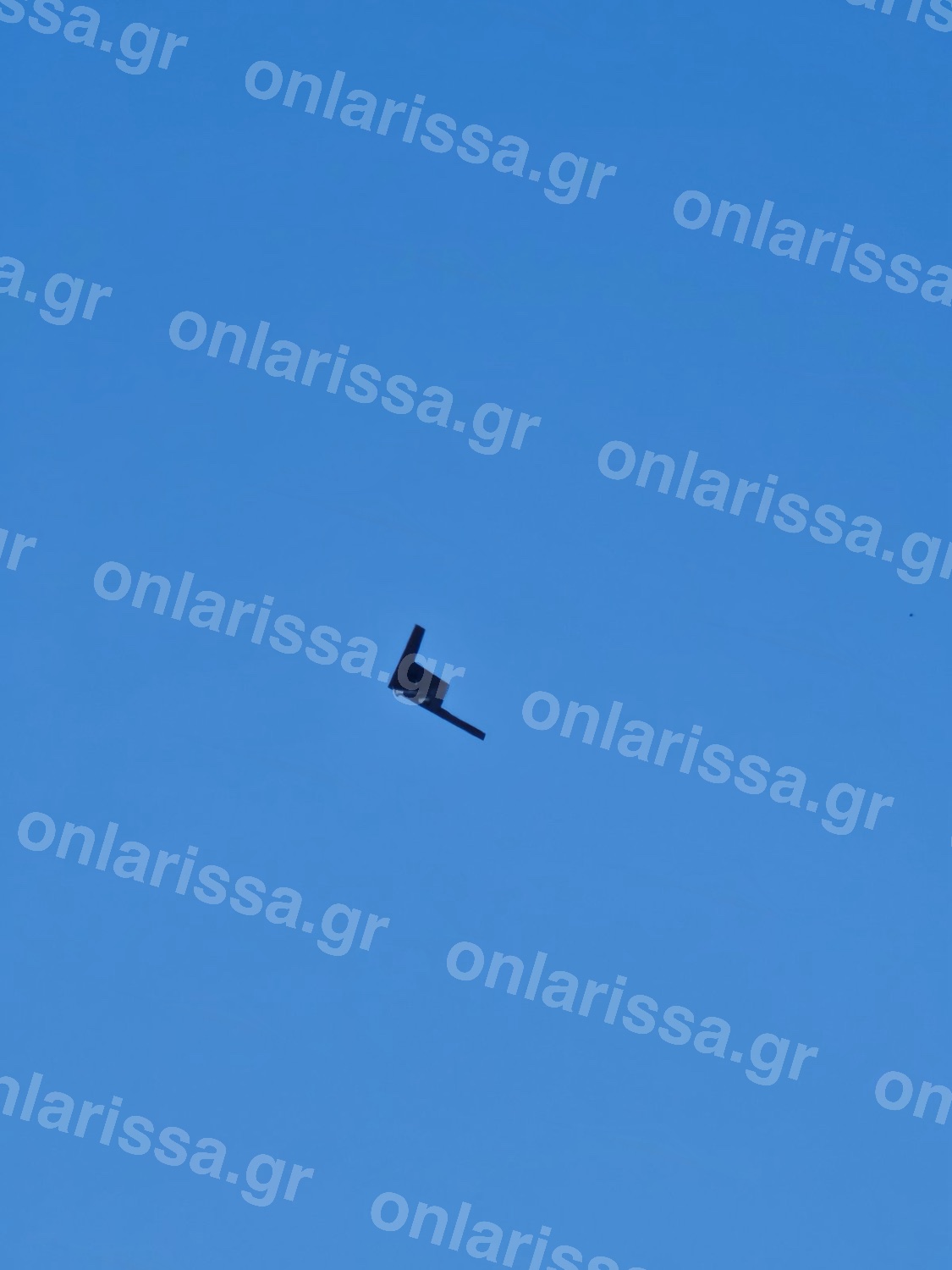
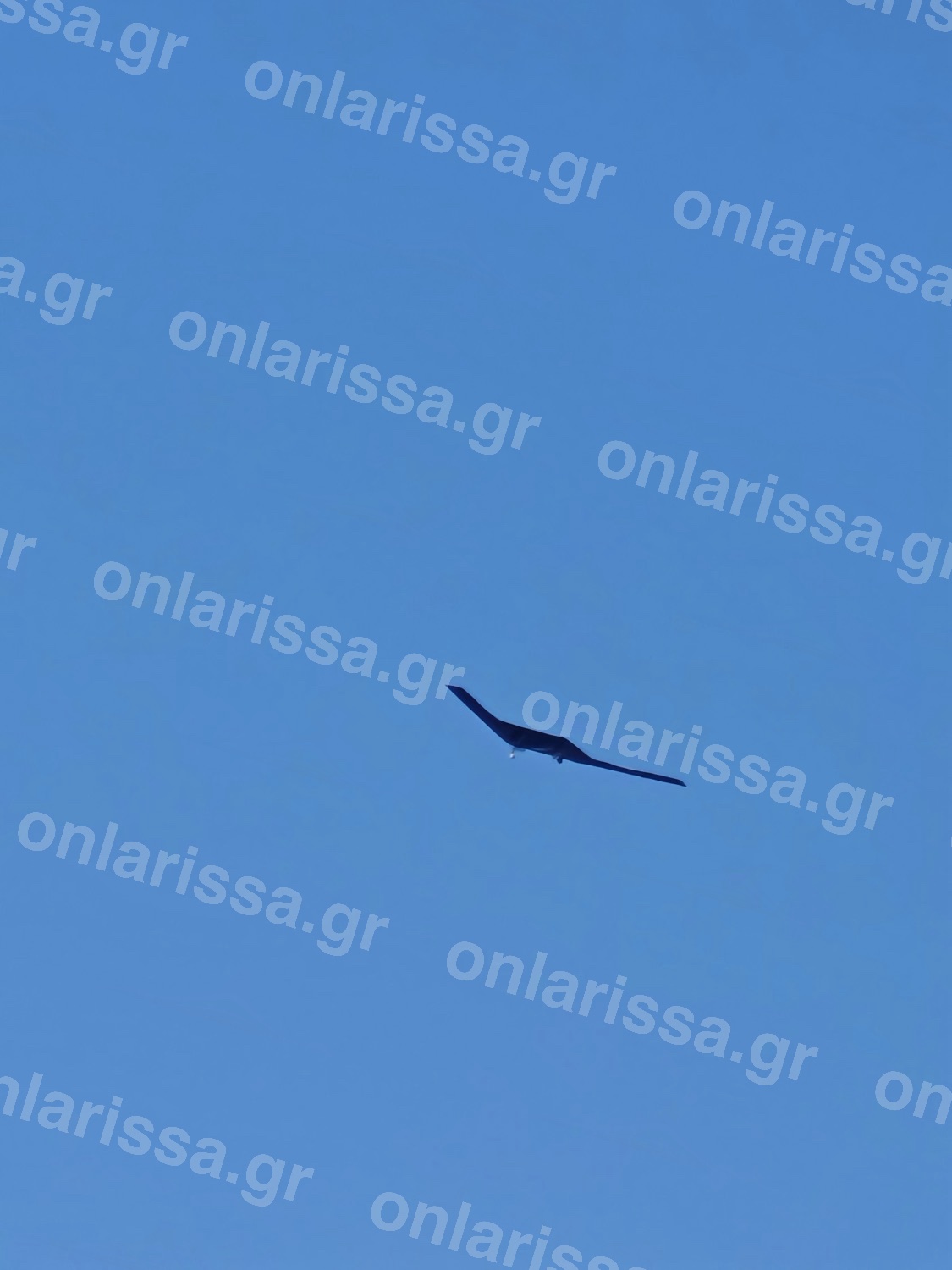
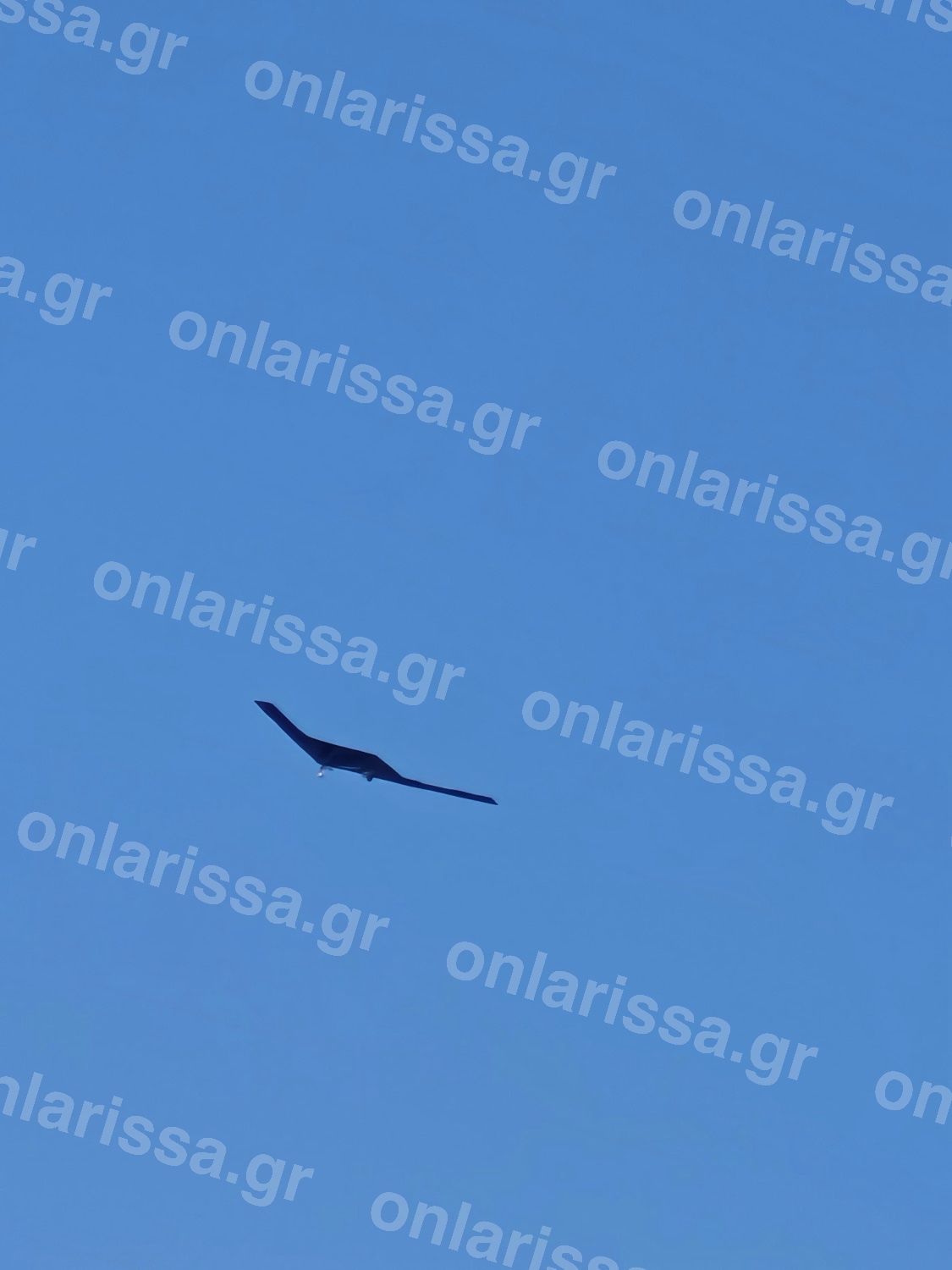
An unidentified flying-wing uncrewed aircraft system (UAS) photographed and videoed at low altitude near Larissa Air Base, Greece, on March 18 offered a rare, high-resolution look at the result of a long-classified military aircraft program.
Online commenters dubbed the Greek intruder as the “Lady of Larissa,” a graceful nod perhaps to the Lockheed Martin RQ-170’s 2009 debut as the “Beast of Kandahar.”
In addition to presenting a black-painted airframe featuring a W-shaped wing trailing edge, the new imagery published by the local OnLarissa news outlet reveals a configuration of a UAS with:
• A relatively deep center body, which would appear large enough for a significant payload bay.
• A highly loaded airfoil with extended, slender outboard sections, the hallmarks of a wing capable of handling large aeroelastic deflections.
• A single-wheel main landing gear and projecting nose gear leg.
• No apparent engine exhaust nozzle when viewed from behind and below the aircraft, which is consistent with a nozzle placed on the upper aft deck for stealth.
• One angle suggests the presence of an exhaust close to the centerline, possibly indicating either multiple engines or a bifurcated nozzle configuration.
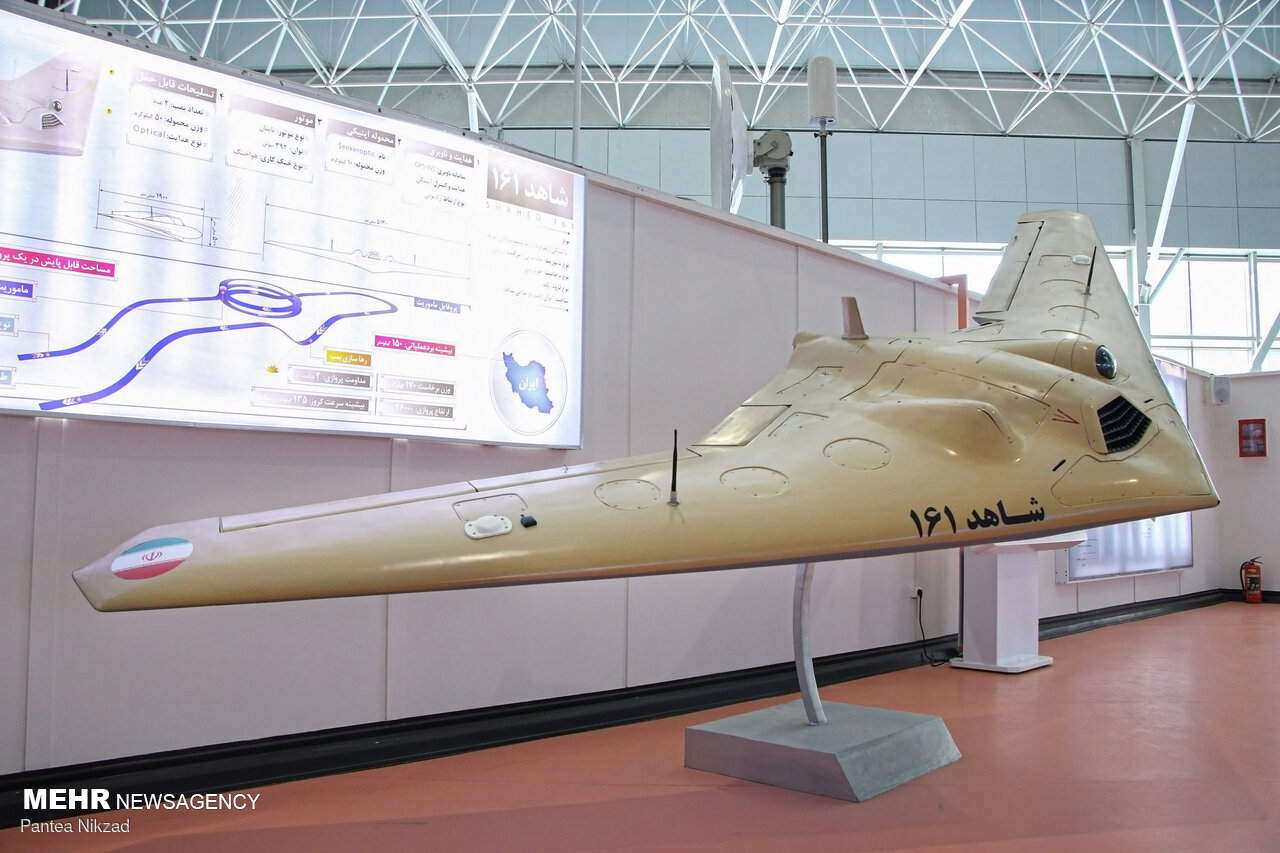
Identifying classified aircraft is always a risky business, but it is even more so lately. The U.S. Air Force still does not confirm the existence of the aircraft Aviation Week identified in 2013 as the Northrop Grumman “RQ-180,” but it is only one candidate. A U.S. intelligence community leak in 2013 also revealed the existence of the classified Israeli RA-1 UAS, which subsequent pictures and videos in circulation reveal to a be a similarly configured, flying-wing aircraft.
A standout feature in the new aircraft imagery is the dark-hued fuselage. Previous Aviation Week reporting and public sightings introduced the RQ-180—also known internally as Shikaka, or “Great White Bat,”—as sporting a soft, white mission livery. Pictures attributed to the RA-1, by contrast, bore a black-painted airframe.
Despite that superficial correlation, an Aviation Week analysis of the new imagery concluded the Lady of Larissa is more likely to be Northrop’s still-classified UAS.
First, a paint change from white to black represents a minor modification, even if it invalidates Shikaka’s nickname. Second, the extended outboard wing sections align more closely with the previous imagery of Northrop’s aircraft, not RA-1. Third, the “RQ-180” likely features weapons bays, as Aviation Week has previously reported, which also aligns with the deep internal bays shown in the configuration of the Lady of Larissa.
And, finally, logistics movements by the U.S. Air Force also point to a non-Israeli origin of activity at Larissa.
Aircraft trackers noted that two Air Force C-17s operated unusual flights on Feb. 25 and March 9 from Edwards AFB, California, to Larissa Air Base. The flight in February flew to the Greek base via Gander, Canada, and Ramstein Air Base, Germany, while the recent flight also routed via Gander with a stop at Spangdahlem Air Base in Germany. Perhaps more significantly, a larger Lockheed C-5M, which is thought may be capable of transporting the “RQ-180” in one piece, also flew to Larissa on Feb. 25 in company with the first C-17, routing from Tinker AFB, Oklahoma, via Spangdahlem.
The involvement of operations from Edwards AFB is significant since the California site is believed to be the main base for the “RQ-180” fleet, despite operations being handled by the 74th Reconnaissance Squadron at Beale AFB, California. As first reported in Aviation Week, RQ-180 testing and development is thought to have been underway at Edwards since 2014 following the first flight of the fifth vehicle at Groom Lake, Area 51, Nevada, in February of that year.
Four years later, following further evaluation and readiness testing, the 417th Test and Evaluation Squadron, an Air Combat Command unit under the 53rd Wing based at Nellis AFB, Nevada, was stood up in April 2018. Ostensibly linked to preparations for tests of the Northrop B-21 bomber, the 417th was instead later identified with the “RQ-180” when the test role for the new bomber was assigned to the 420th Test and Evaluation Squadron.